Eastern North America Cools as the Northern Hemisphere and the Arctic Warm
World-wide average temperatures are rising. But we have always expected pockets and regions where temperatures are either warmer or colder than average. Now, with warming underway, we are seeing where these pockets are forming, and northeastern North America is turning out to be a cooling region.
So what’s happening here?
Even a small amount of warming soon yields a lot of warming in the Arctic where the bright-white and reflective sea ice melts and exposes the darker, sun-light absorbing water. Though a visit to the high Arctic might still require warm clothing, temperatures have risen dramatically relative to the norm and consequently the temperature difference between the Arctic and mid-latitudes has gotten smaller. We say that the temperature gradient has weakened.
And a weaker temperature gradient doesn’t confine the Arctic Jet Stream to a narrow north-south band the way a stronger gradient does. That is, it meanders more, heading farther north and south on its eternally eastward flow.
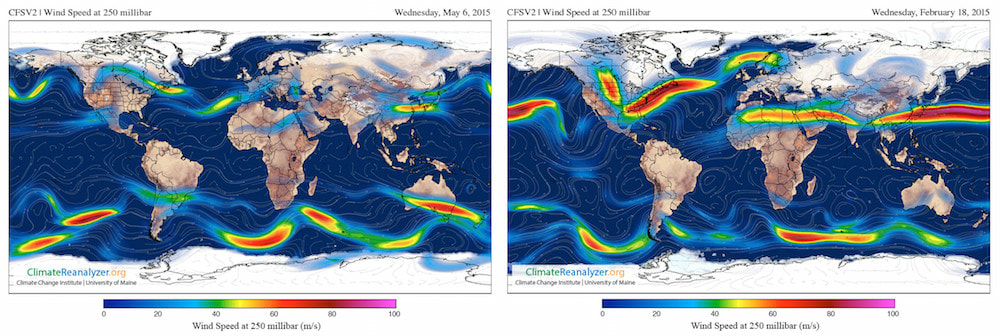
Over the past two boreal winters, this increased meandering has included a northward meander in the Central Pacific, far enough west to put the western U.S. into severe drought, and a southward meander over northeastern North America bringing cold and snow.
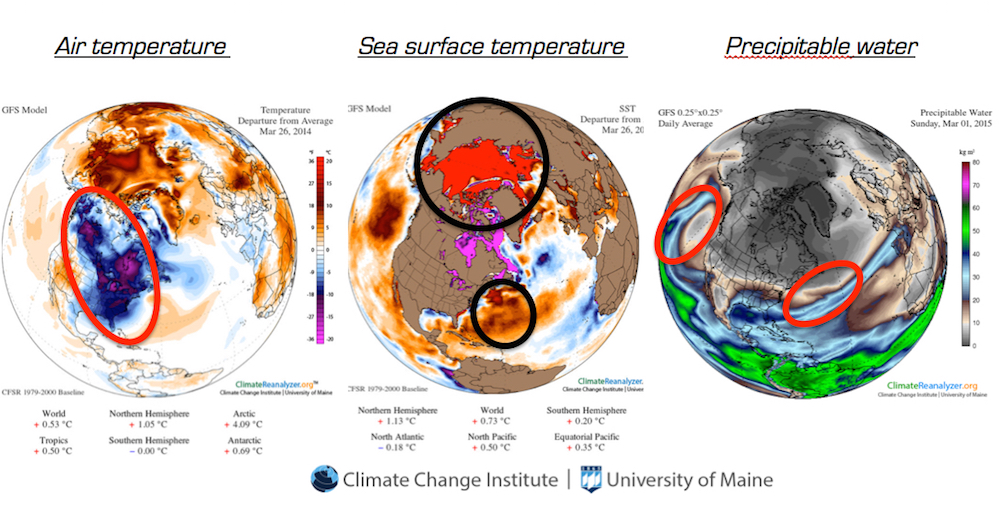
As we discovered in the GISP2 ice core, when climate changes abruptly it often begins with abrupt shifts in atmospheric circulation: we are now getting to see such a change in our own time; a result of our own, human-caused rapid climate change. It is scientifically fascinating. So long as one doesn’t think about the human, ecosystem, economic, and security devastation it represents.